Doing It All Again
Passing Down Wisdom Through the Seasons of Sheep
by Gowan Batist
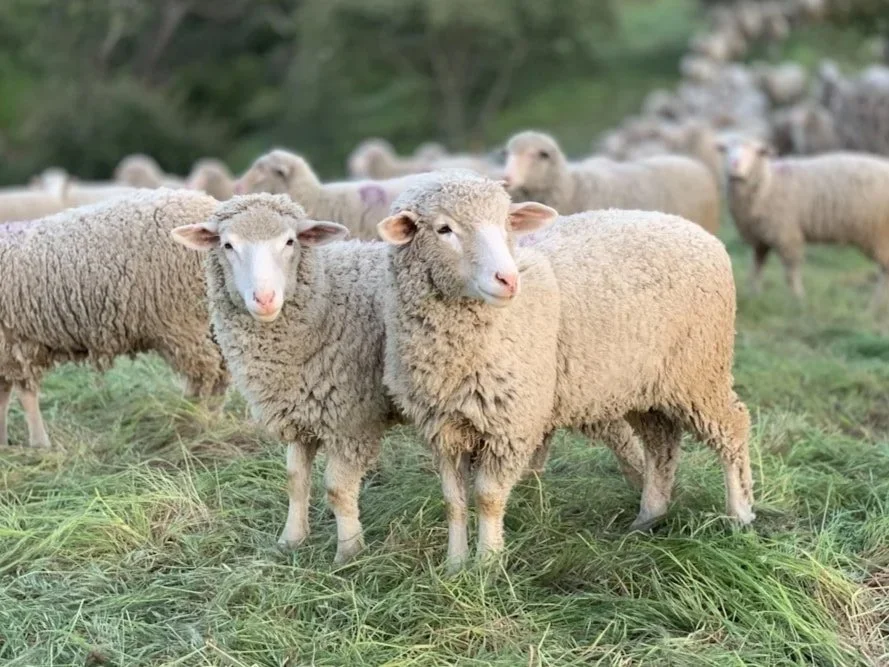
When my peers were out dancing at clubs, I spent nights rubbing lambs with dry straw. I’d watch them carefully for signs of hypothermia, dressing the smallest in little wool coats, tucking them into little wire pens with their mothers under red heat lamps—which always made me fear fire in the straw. I hovered so close in those days, sleeping in my camper shell, pulled up to the doorway of the barn.
Then we started raising Finnsheep, which, unlike manysheep, will happily breed in any season. We decided that since we don’t raise lamb for meat and aren’t tied to a market schedule, we could lamb any time we pleased. January is not my preferred time for 2am barn checks, so we simply don’t lamb in the winter anymore.
My family was hoping to welcome a human baby in April, so we didn’t plan on any lambs before then. However, following a traumatic loss involving a helicopter ride to Santa Rosa for emergency surgery, I decided there would still be new life on the farm in April, and let the ram in with a small group of ewes.
The flock spent a few winter months over the hill in Ukiah with Headwaters Grazing for a contract grazing cover crops on a wonderful vineyard. We have done this for quite a few years in a row now. What made this year extra special is how Azra, our veteran livestock guardian dog, was also training their new guardian pup in proper flock etiquette and predator deterrence.
The rich diet of cover crops and mineral supplements always brings the sheep back to us with sleek bodies and beautiful wool, even when it gets a little felted where they walk under the vines and rub against posts. Once the sheep come home and are sheared, relieving them of their winter coats, they go onto the best coastal pasture, and then the pregnant ewes are pulled away to their own paddock where they can receive extra calories and careful observation.
Lambs ideally dive into the world, with their noses and front hooves presenting together. The ewes often pace and dig at the ground, laboring on their sides for long stretches, but at the moment of delivery, almost always stand up, using the extra help of gravity to bring their lambs to the earth. When my own baby was born I did the same, feeling the sudden urge to get vertical, right at the point of delivery.
The vast majority of the time, birth works on its own. Every now and again, we need to step in, but always with as little force as possible. Our elderly livestock guardian dog Chego is a veteran of many lambing seasons, and once kept a baby lamb alive when the ideal nose and hooves presentation did not happen. I arrived at the field to find a ewe laboring with a lamb whose head was delivered, but with hooves swept back, nowhere in sight, and difficult to reach. This presentation usually doesn’t survive, but Chego, curled around the ewe, had been licking the lamb’s nose and mouth clear, and the lamb was visibly breathing. Quickly, with the help of friends who held the poor ewe, I reached past the lamb’s head and found the front legs, hooking a fingertip around the knees one by one and pulling them forward. The little lamb was born. She has grown into a flock matriarch herself, alongside her now venerable mother. The team at Headwaters let me know that Iris, the lamb born that day back in 2018, is always the leader-sheep on pasture moves.
The sheep on our farm live out their natural lives, so we don’t need to have lambs often. Our flock tends towards the elderly, so we aim to lamb at around the replacement rate of their natural lifespan. The main purpose of the sheep flock is to maintain the pastures for accessibility and fire safety, and keep invasive plants from growing out of control. Their byproduct is luxurious fiber. Because we don’t have lambs often, each birth is exciting. Last season was our toddler’s first experience with lamb births, and we named the brown twins with his help: the ewe StellaLuna, after the children’s book about a bat, and the boy Avi, for the month of Av, when he was born. Those two little brown lambs, who are still fairly small, come up to our toddler for petting and allow themselves to be leaned on, hugged, and stroked. I can’t wait for their first shearing, and what we will make for our little shepherd out of their soft fleece. I hope they live long lives, as long as their great-grandmother, who lived to be 15. Our child may shear them alone in the pasture as a teenager, like I did at that age.
We can’t count lambs before they’re born, but I have hopes for what the ram’s gorgeous curls will do blended with the beautiful colors of the ewes. I hope we get a crowd of friendly, happy pasture managers whose fleece will grace the spindles and looms and laps and necks and heads of our community for the next decade or more.
Those are my hopes, but we never know what will happen.T.S. Eliot said, “April is the cruelest month, breeding lilacs out of the dead land, mixing memory with desire, stirring dull roots with spring rain.” I have definitely had my share of Aprils that reinforce his point for him.
In April, the grass is mostly water, and the sheep move fast through the pastures. The energizers on the electric strands easily ground out on the wet grass. The predators are having their babies, too, and are hungry. The pantry is growing hollow and boring. The new vegetables arethin, and the garden runs hard to slug-marked greens. All the spring bills come in, and none of the summer money is there to meet them yet. It feels like an unkindness to shake us loose from our winter burrows ... but then come the lilacs and the lambs, and they convince us to get up and do it all again.
Gowan Batist of Fortunate Farm is a Post-Industrial Pastoralist following sheep around the skeleton of a boom town. She is seldom seen, but sometimes glimpsed with a baby on her back, propagating native plants, spinning wool, hand shearing sheep, or meal prepping baby food with local bulk food via the MendoLake Food Hub.
